Two Muted Figures
19 June 2026
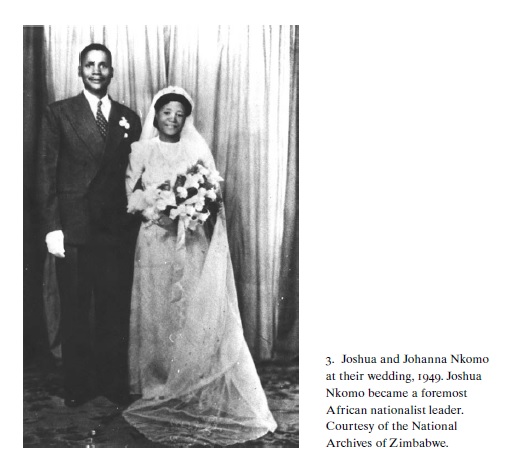
Two early middle class black leaders who did not quite fit in with either the radicals or the business class were Joshua Nkomo and Isaac Samuriwo.
|
|
Stereotypically, centrists were businessmen while radicals were either clergymen like Ndabaningi Sithole and Canann Banana or schoolteachers like Bob and Sally Mugabe. But Joshua Nkomo was a union leader. A smooth operator and a natural politician, by the end of the 1950s he had made connections among both the white power structure and the black radicals of the Southern Rhodesia African National Congress (SRANC).
He was tasked by the whites to raise support for the Central African Federation in the 1950s and for the new Southern Rhodesian constitution of 1961, which he had a hand in drafting. The new decade was expected to be one of increased black political participation and Nkomo was assumed to be someone who would play a leading role. And so he did, but not in the way the whites had expected.
Sensing a change in the political winds at home and abroad, Nkomo founded the National Democratic Party (NDP) to take up the role of the now disbanded SRANC. He used the NDP to enforce by violence a boycott of the first election to be held under the constitution he had once supported. He also gained the patronage of both the British and of Kenneth Kaunda of Northern Rhodesia, soon to be the first president of Zambia. It is likely that Kaunda and the British and Nkomo himself all saw him very soon assuming the leadership of Southern Rhodesia under a universal franchise alongside Kaunda in the north.
When NDP was banned, Nkomo formed the Zimbabwe African People’s Union (ZAPU) with his NDP associate Ndabaningi Sithole. This was the first time the name “Zimbabwe” had been used as a proposed country name. It had previously been a noun referring to various stone structures found around the country, in particular the Great Zimbabwe, which is still a popular tourist attraction today. Personal differences pushed Sithole out of ZAPU. Sithole then formed the rival Zimbabwe African National Union (ZANU).
A jovial man who loved the good life and was always two steps ahead of the game, Nkomo was not a radical at heart. While he used urban unrest and outright terrorism for his own ends and rose to command a mighty army under the Zimbabwe People's Revolutionary Army (ZIPRA) that was in many ways better armed and better trained militarily than ZANU’s Zimbabwe African National Liberation Army (ZANLA), Nkomo did not have the intuitive grasp of guerilla liberation tactics of his rivals and was overpowered politically and forced to flee the country when the war ended. He seemed genuinely surprised when political violence was used against him.
After the destruction of ZIPRA, Nkomo was allowed to return and in 1990 was made vice-president under Mugabe, a purely ceremonial role. It was not much better than the symbolic titles given to cooperative whites. He held the role until his death in 1999. Looking back, Joshua Nkomo had played a more meaningful and constructive role in the politics of Rhodesia in the 1950s and early 1960s than he was ever to play in Zimbabwe.
There are no publicly available pictures of Isaac Samuriwo. He was the son of the chief of the Samuriwo clan who remain influential in Zimbabwe. Perhaps they have pictures of him. Doris Lessing quotes an article about Samuriwo as an up and coming business leader in the newspaper The African Weekly, June 6, 1956. She calls him a “useful rebel” by which she means to say he is useful to the white establishment.
Born in 1913, Samuriwo had by 1956 attained several scholastic degrees and founded several successful businesses, principally in construction and transportation. The African Weekly says he was “the first president of the Southern Rhodesia African Chamber of Commerce and is now president of the Southern Rhodesia African Transport Operators’ Association.” Before that he had worked at many menial jobs and also several teaching jobs and government positions. He had recently become Chairman of the Harare district branch of the ruling United Federal Party (UFP). The article quotes him as saying he owes all his success to truth, hard work and fearlessness. By some accounts, he was a member of the federal parliament in the late 50s and early 60s, but further research would be required to determine this more authoritatively.
Mr. Samuriwo would a few years later leave the UFP, as did Ian Smith, to join the fledgling Rhodesian Front (RF). By some accounts, he was directly involved in the founding of the party together with Smith and Douglas "Boss" Lilford. Given his considerable business holdings, he was likely at the least a financial contributor to the young party. He was also almost certainly eligible to vote and run for a seat on the “A” roll in 1962. It is telling that he did not. Even as a successful black businessman who supported Winston Field and Ian Smith, he did not expect that a 90% white electorate would vote for him over a white man.
He ran instead on the RF ticket on the “B” roll and lost to a black UFP candidate. But neither did Samuriwo wish to join the black middle class centrists like Percy Mkudu or Josiah Gondo who advocated for the universal franchise. Samuriwo ran again in 1965 and was elected as an independent.
After the racialization of the voter rolls in 1969, Samuriwo ran in the 1970 election and lost in a crowded race in a tribal district. He seems to have had few enemies and likely died in peace, but he was not to play a visible role in either Rhodesia or Zimbabwe. He is mentioned in a few Zimbabwean newspaper articles as an early business leader and one of the first residents of Marimba Park, the first affluent black suburb of Salisbury that was established in 1960.